







I’m just back from a research trip to Silhouette Island in the Seychelles.
(The full list of my favourite clues and signs from that trip can be found in The Collection.)
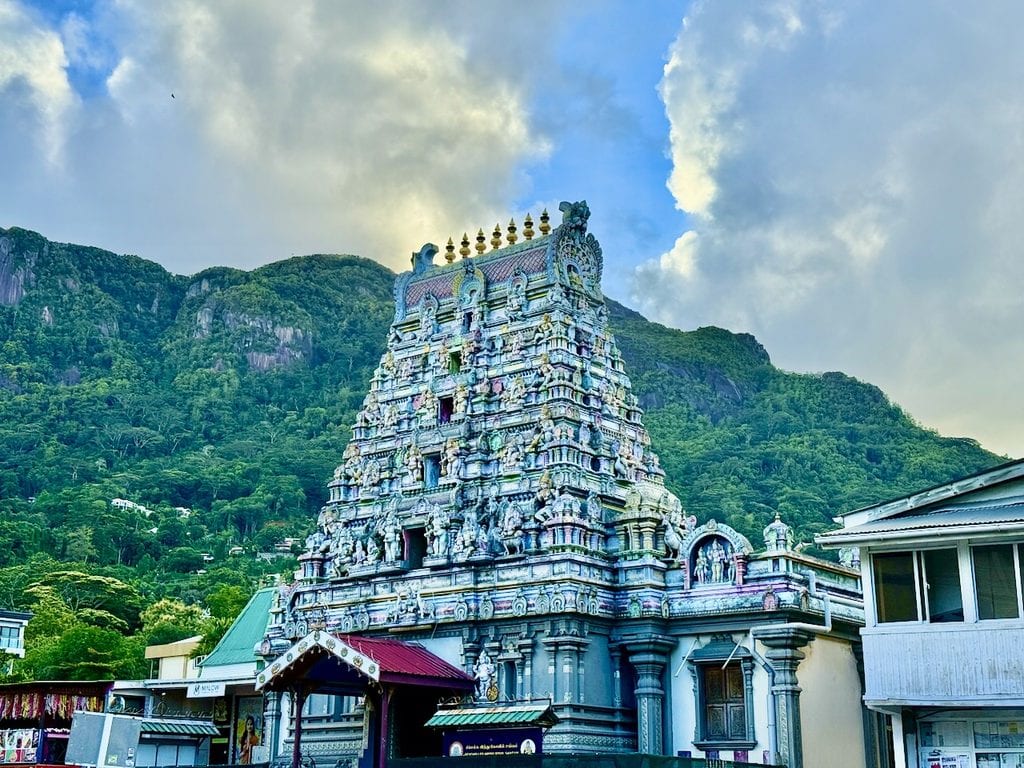
On my journey there, I visited the stunning Arul Mihu Navasakthi Vinayagar Hindu Temple in Victoria, on Mahé, and it was a good excuse to take a deep dive into the alignment of Hindu temples, the reasons behind this and any possible role in natural navigation.
The Typical Alignment of Hindu Temples and Their Relationship with Cardinal Directions
Hindu temples are rarely placed at random. Their layout follows Vastu Shastra and the Agama texts, ancient systems of architecture that seek harmony between a building, natural forces and the universe. They treat the temple as a model of the cosmos and set rules for its orientation, proportions and plan. These principles travel wherever Hindu communities settle: the Arul Mihu Navasakthi Vinayagar Temple in Victoria, on Mahé, the only Hindu temple in Seychelles, is a smaller version of the Dravidian temples of South India. The most consistent rule concerns direction: the great majority of temples face east.
In an east-facing temple, the entrance, the assembly hall (mandapa) and the inner sanctum (garbhagriha) lie along a single east–west axis. The worshipper walks from the doorway towards the deity, while the deity looks out towards the rising sun. In some temples the first rays of morning light fall directly on the image in the sanctum, joining the deity to the life-giving power of the sun. In South Indian temples the axis begins at a towering gateway, the gopuram; in Victoria, a five-tier rajagopuram completed in 2008 now marks the entrance.
The reasons are largely symbolic. The east is the direction of Surya, the sun, and of dawn, associated with light, knowledge and auspicious beginnings. Fittingly, Victoria’s presiding deity is Ganesha, remover of obstacles and god of new beginnings. Each direction also has a guardian, or dikpala: Indra rules the east, Varuna the west, Kubera the north and Yama, god of death, the south.
These guardians are mapped onto the temple’s ground plan, the Vastu Purusha Mandala, a square grid representing the ordered universe. The sanctum sits at its centre, the spiritual heart of the cosmos, while the surrounding halls and shrines reflect its arrangement. Aligning the building with the cardinal points makes the temple a meeting point between the human and the divine.
The cardinal axes also shape ritual. Devotees walk clockwise around the sanctum (pradakshina), echoing the sun’s daily path. Festivals carry this movement beyond the walls: each August or September, Victoria’s chief deity is drawn through the town in a night-time chariot procession.
East is the norm, not an absolute rule. Some temples face other directions because of the deity enshrined, local tradition or the site available. Shrines to fierce deities such as Bhairava, whose icon stands in Victoria’s inner mandapam, sometimes face south, towards Yama. Practical history matters too: Seychelles’ Hindus worshipped in a rented upper room on Quincy Street before their temple was consecrated there in 1992.
Ultimately, a temple’s orientation brings together sunlight, sacred geometry and cosmology. From the Ganges plains to a small capital in the Indian Ocean, every temple expresses harmony between humanity, nature and the divine.
You might also enjoy:
The Collection – Hundreds of photos and videos of outdoor clues and signs
