





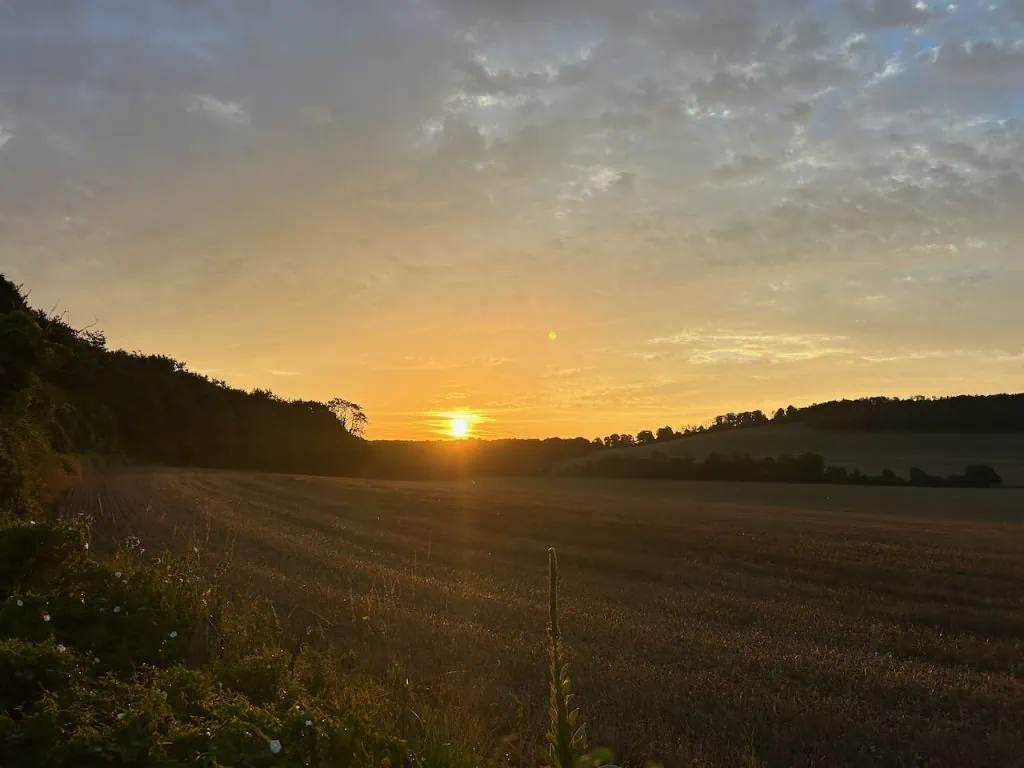
We can work out when the sun will rise or set using tables and by understanding our location well.
If you look online or at a table or almanac, it will tell you the time that the sun rises and sets in your part of the world. But there is an art to understanding the time of sunrise and sunset. The better-known part is that these timetables apply to a local city or focal point, hopefully not too far from you. If you are not in that exact spot (highly likely), then the times will vary. They will be later if you are west of that spot and earlier if you are east of it, because the sun will reach you later or earlier as the earth spins east towards the sun.
If you are north of that location, the sunrise and sunset will be nearer to midday and if you are south of it, they will be nearer to midnight. In other words, the winter days are squeezed shorter as we travel north away from the equator and spread longer as we travel south towards the equator. (The opposite is true for north and south in summer, at the equinoxes there is little effect as everywhere experiences an equal length of night and day).
These are the inescapable effects of living on a rotating sphere and receiving light from a star that is 93 million miles away.
Time Travel
There is another area we have little control over: the shape of the land. Imagine watching the sun dip behind a hill as it sets; the person on that hill will be standing in sunshine for minutes after we have declared the sun to have set.
We can watch this effect in real time if we turn our backs on the sunset and look to a hill to our east. We are in shade and the sun has sunk, but the top of the hill to our east is still bathed in sunlight. The person on top of that hill is east of us and so should, in theory, have seen sunset before us, but they are higher and so the sun sets later.
We can watch the same effect on an even larger scale at the start or end of the day, when there are clouds opposite the sun but none blocking it. Watch how the clouds see daybreak in the western sky minutes before we do and enjoy it for minutes longer at sunset in the east. This can be a particularly beautiful effect, as we can watch the colours we associate with a low sun, yellows, oranges and reds, march up or down the clouds.
We have no control over the rotation of the Earth, the angle of the sun or the shape of the land, but we can control where we stand within a landscape. We can bend time by moving up or down a slope. Clear days in midwinter are the best time for this game, as we are more likely to be out and about near sunrise and sunset times. I have had so much childish fun over the years by playing the tape of sunrise or sunset forwards or backwards by running up and down hills. I am in my fifties now and still doing it regularly. The sun has set, up the hill I jog, oh no it hasn’t! The sun has risen, down the hill I trot, oh no it hasn’t! There is a reason I have to walk alone so much of the time, but it escapes me.
You might also enjoy:
The Difference Between Sunrise and Sunset
The Art of Perception in Nature
The Beginner’s Guide to Natural Navigation – Online Course