








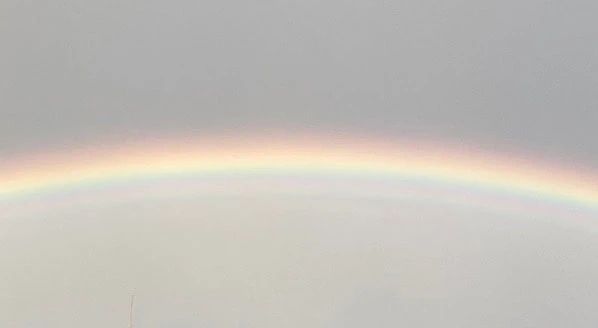
Supernumerary rainbows are faint bow lines that appear just inside the main rainbow.
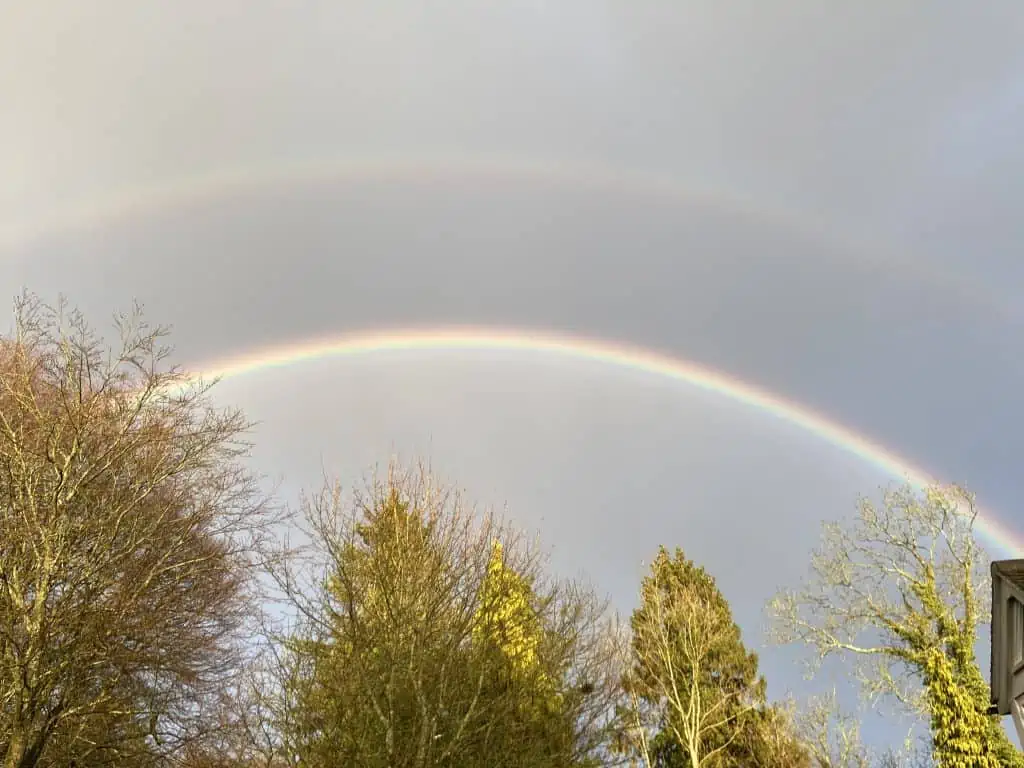
Look at the rainbow above and you may just be able to make out some of the normal colours. From top to bottom: red, orange, yellow, green, blue, indigo and violet. (Richard Of York Gave Battle In Vain – or however you remember it.)
At the bottom, just below the violet, there are some fainter lines with little colour. These are the supernumerary bows.
They are caused by interference between the different wavelengths as the light travels towards our eyes. They are so sensitive to changes in raindrop size that you will see them fluctuating from one moment to the next and even from one side of the rainbow to the other in the same moment.
Every colour in a rainbow is telling us something about the rain. A deep red colour means that the rain is especially heavy. “Lots of red, means a wet head.”
Supernumerary bows mean the opposite to a deep red at the top: the raindrops are very small. For this reason it is very unlikely you will see the two together. Look again at the bow above and you’ll spot that there is a good orange colour at the top, but not much true red.
You will have seen that there is a ‘secondary rainbow’ above the main one. Secondary bows are quite common and always:
- Appear fainter than the main bow
- Have colours reversed, with red on the inside of the bow and violet on the outside.
For a full guide to reading rainbows, see The Walker’s Guide to Outdoor Clues & Signs (UK) / The Lost Art of Reading Nature’s Signs (US/International).

Supernumerary Rainbows: Fun Facts
They helped show that light is a wave. Descartes and Newton explained the main rainbow with rays bending and reflecting inside raindrops. That ray model predicts a single bow and nothing more, so the extra bands were a puzzle. In 1803–04 Thomas Young explained them as interference. Two light paths through the same droplet can leave at the same angle after travelling slightly different distances. They then reinforce or cancel each other, which produces alternating bright and dark fringes. The rainbow became one of the early pieces of everyday evidence for the wave theory of light.
They were noticed before anyone could explain them. The clergyman Benjamin Langwith described them to the Royal Society in 1722. He was puzzled that the colours didn’t match Newton’s account. Attempts to explain them with ray optics failed for about 80 years.
They gave mathematics a famous function. In 1838 George Airy worked out how the intensity of light varies near the rainbow’s edge. To do it, he invented what is now called the Airy function. It turns up all over physics, from quantum mechanics to optics, but it began as a rainbow calculation. Airy’s theory also showed that the brightest part of the bow sits slightly inside the angle that simple geometry predicts.
They tell you the size of the raindrops. Smaller drops spread the supernumerary bands further apart. Large drops, roughly over 1 mm, pack them so tightly that they blur into the main bow. A mix of drop sizes washes them out entirely. So when you see crisp supernumeraries, the shower is made of small, fairly uniform droplets. Engineers use the same principle in “rainbow refractometry,” a laboratory technique that measures droplets in sprays and fuel injectors from their rainbow fringes.
They favour the top of the arc. Falling raindrops flatten as they fall, and larger ones flatten more. Because of this, supernumeraries are usually clearest near the top of the bow and fade towards the ends.
You can make your own. A fine garden hose mist on a sunny day can produce them, because spray droplets are small and fairly even in size. The same effect shows up in fogbows and cloudbows. There the droplets are so tiny that the whole bow turns broad and almost white, sometimes with a faint supernumerary band inside.
They’re not the same as “twinned” rainbows. A twinned rainbow is a rarer sight, where one bow splits into two from a single base. It’s thought to come from a mix of differently sized, flattened drops, and it is a separate phenomenon even though the two are often confused.

You might also enjoy:
The Secret World of Weather – The Book