








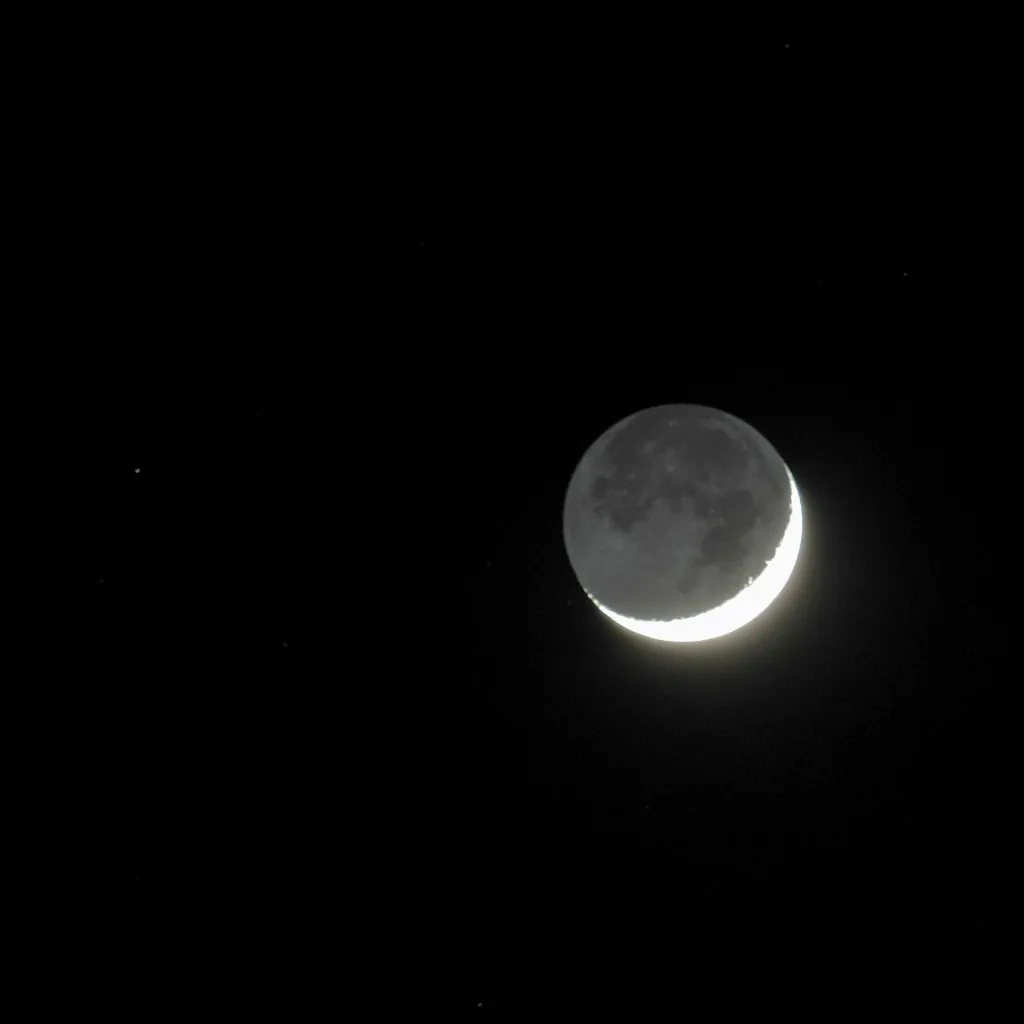
Earthshine is one of those subtle phenomena that many people have seen without ever realising what they were looking at. On certain evenings, a thin silver crescent Moon hangs in the sky, yet the remainder of the Moon is also faintly visible, glowing with a soft grey light. This delicate effect has long been known as the “old Moon in the new Moon’s arms”.
The explanation reveals an elegant relationship between the Earth, Moon and Sun. Although we usually think of the Moon as the great reflector in our skies, there are moments when the Earth takes on that role instead. Sunlight strikes our planet and is reflected back into space. Because the Earth is larger and more reflective than the Moon, enough of this light reaches the Moon to illuminate its night side. That gentle glow then returns to our eyes, allowing us to see the Moon’s full outline embracing its bright crescent.
This effect is easiest to see a few days either side of a new Moon. It rewards patience rather than equipment; a careful observer needs only a clear sky and a willingness to linger.
The phenomenon fascinated early astronomers. Galileo recognised that this pale illumination was not produced by the Moon itself but by sunlight reflected from Earth. In doing so, he demonstrated that our world behaves much like the other planets, reflecting light into the darkness around it.
Today, earthshine offers more than simple beauty. Scientists use it to study Earth’s albedo — the amount of sunlight our planet reflects back into space. Clouds, forests, oceans and ice all influence this measure, providing valuable clues about our changing climate.
Earthshine is a reminder that the sky is full of quiet exchanges. Even the faint glow on the Moon tells a story about the world beneath our feet, and about the close relationship between our planet and its nearest companion.
You might also enjoy:
How to Tell if You Looking at a Full Moon
How to Navigate Using the Moon
Books on Nature’s Clues and Signs